


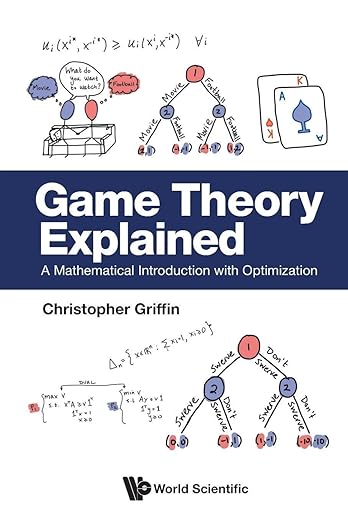
Description
Game Theory Explained: A Mathematical Introduction With Optimization.
This book offers a rigorous yet accessible introduction to the mathematical foundations of game theory, combining classical game-theoretic concepts with modern optimization techniques to provide a comprehensive understanding of strategic decision-making. Designed around a theorem–proof–example format, it not only presents the central results of game theory but also demonstrates the mathematical reasoning behind them, enabling readers to develop both conceptual understanding and proof-writing skills.
Unlike many introductory texts that focus primarily on applications or intuition, this book emphasizes the underlying mathematical structure of game theory. Each topic is carefully developed through formal definitions, detailed proofs, and illustrative examples, helping readers understand not just what the major theorems state, but why they are true and how they can be applied to real strategic problems.
The first part of the book introduces the classical foundations of game theory. It begins with a practical introduction to probability through the analysis of casino games, providing readers with the probabilistic tools needed for later chapters. From there, it develops essential concepts including utility theory, strategic and extensive-form games, game trees, mixed strategies, and the celebrated minimax theorem. The section culminates with John Nash’s landmark proof establishing the existence of mixed-strategy equilibria in finite general-sum games, one of the foundational results of modern game theory.
Throughout these chapters, theoretical discussions are reinforced with carefully selected examples that illustrate how mathematical models can describe competitive and cooperative decision-making across a wide range of situations.
The second part shifts attention to optimization theory, demonstrating how many game-theoretic problems can be formulated and solved using optimization methods. Readers are introduced to key concepts in mathematical optimization, including constrained optimization techniques and the Karush–Kuhn–Tucker (KKT) conditions. The book explains how strategic interactions can be translated into optimization problems, providing powerful computational tools for identifying Nash equilibria and analyzing strategic behavior in increasingly complex settings.
The final part explores cooperative game theory, where players can coordinate their actions and share outcomes for mutual benefit. This section presents a fresh perspective by formulating Nash bargaining as a multi-objective optimization problem, highlighting the close relationship between bargaining theory and optimization. It also revisits important concepts from linear programming and duality theory to provide elegant proofs of classic results, including the influential Bondareva–Shapley theorem, which characterizes the existence of stable allocations in cooperative games.
To ensure that readers have the mathematical background needed to succeed, the book includes two appendices reviewing essential prerequisite material. An additional bonus appendix introduces evolutionary game theory, offering a self-contained overview of replicator dynamics and evolutionary models of strategic interaction. This modern perspective provides instructors with the flexibility to incorporate contemporary topics alongside—or in place of—some of the more traditional material, making the text adaptable to a variety of courses.
Blending rigorous mathematical treatment with practical examples and clear exposition, this book serves as an excellent resource for advanced undergraduate and graduate students studying mathematics, economics, operations research, computer science, engineering, and related disciplines. It is equally valuable for researchers and practitioners seeking a deeper understanding of the mathematical principles that govern strategic interaction, optimization, and decision-making.
By integrating classical game theory with modern optimization methods, the book equips readers with both the theoretical foundation and analytical tools needed to study one of the most influential fields in applied mathematics.



Reviews
There are no reviews yet.