


Description
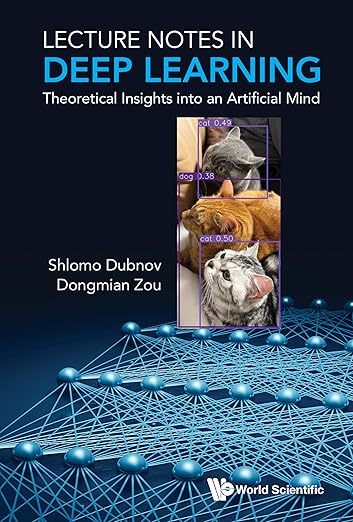
Lecture Notes in Deep Learning: Theoretical Insights into an Artificial Mind.
This comprehensive compendium offers a clear and accessible introduction to the theoretical foundations of deep learning, guiding readers from the core principles of neural networks to some of the field’s most advanced concepts. Rather than focusing solely on practical implementation, the book explains why deep learning models work, providing the mathematical and conceptual understanding needed to build a deeper appreciation of modern artificial intelligence.
Beginning with the fundamentals, the book introduces neural network architectures, learning algorithms, optimization techniques, and the key principles that enable deep learning systems to recognize patterns and solve complex problems. As readers progress, they are introduced to more sophisticated topics, including neural networks viewed as Gaussian processes, neural tangent theory, and information-theoretic approaches that offer powerful insights into how deep learning models learn, generalize, and process information.
Unlike many highly technical texts, this volume strikes a careful balance between rigor and accessibility. It presents complex theoretical ideas in a way that is approachable for upper-level undergraduate students while remaining valuable for graduate students, researchers, and practicing professionals. Clear explanations and intuitive discussions help bridge the gap between mathematical theory and practical understanding, making advanced concepts easier to grasp without sacrificing scientific depth.
The later chapters broaden the reader’s perspective by exploring deep learning through the lenses of statistics and information theory. These interdisciplinary viewpoints reveal the relationships between neural networks and other statistical modeling techniques, helping readers understand how deep learning fits within the broader landscape of machine learning, probability, and data science. By connecting these fields, the book provides valuable intuition about the strengths, limitations, and underlying principles of modern AI systems.
Designed as both a learning resource and a long-term reference, this compendium is ideal for students, educators, researchers, and professionals working in artificial intelligence, machine learning, data science, and information systems. Whether you are building a solid theoretical foundation or seeking a deeper understanding of today’s most influential AI technologies, this book offers a thoughtful, well-structured guide to the science behind deep learning.


Reviews
There are no reviews yet.