


Description
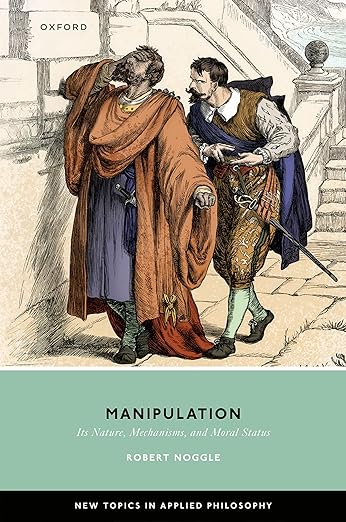
Manipulation: Its Nature, Mechanisms, and Moral Status
Gaslighting, flattery, misdirection, persistent nagging, emotional blackmail, charm offensives, and appeals to sentiment—all of these are familiar forms of everyday manipulation. While often subtle and socially normalized, they play a significant role in how people influence one another in daily life. Yet despite their frequency, manipulation is widely regarded as something morally troubling, raising important questions about what it actually is, how it operates, and why it tends to feel ethically wrong.
In Manipulation: Its Nature, Mechanisms, and Moral Status, philosopher Robert Noggle offers a systematic answer to these questions by developing a clear and structured account of manipulation. The book begins by addressing the challenge of definition: what do all forms of manipulation have in common that distinguishes them from other kinds of influence such as persuasion, education, or rational argument? Noggle proposes a unifying idea known as the “Mistake Account,” which defines manipulation as a form of influence that works by causing the target to form a mistaken belief, judgment, or mental process that leads them toward a desired outcome.
Building on this framework, the book explores the psychological mechanisms that make manipulation effective. It examines how manipulators exploit predictable features of human cognition, including biases in judgment, shortcuts in decision-making, emotional vulnerabilities, and the tendency to favor immediate rewards over long-term benefits. It also considers the broader limitations of human reasoning, emphasizing that even well-intentioned individuals are susceptible to error under certain conditions. These cognitive weaknesses create openings through which manipulation can operate, often without the target being fully aware of it.
The book then turns to the moral dimension of manipulation. Noggle argues that manipulation is generally presumptively wrong because it involves leading someone into error, and error itself is typically harmful. However, he also contends that this presumption can, in rare and exceptional cases, be overridden when the consequences strongly justify it. In most circumstances, though, manipulation remains ethically problematic—not only because it produces mistaken beliefs, but also because its more serious forms can undermine personal autonomy and reduce overall well-being.
Finally, the book applies the Mistake Account to a wide range of real-world contexts, including advertising, sales techniques, behavioral conditioning, cognitive priming, digital influence, and “nudging” in policy design. By doing so, it shows how deeply embedded manipulation is in modern social, economic, and technological systems, and how difficult it can be to separate legitimate influence from ethically questionable practices.
Through its careful analysis, Manipulation: Its Nature, Mechanisms, and Moral Status provides a powerful framework for understanding how influence works in everyday life, why it so often succeeds, and what makes it morally significant. It ultimately encourages readers to think more critically about the subtle ways in which decisions are shaped—and how easily human judgment can be led astray.


Reviews
There are no reviews yet.