

Description
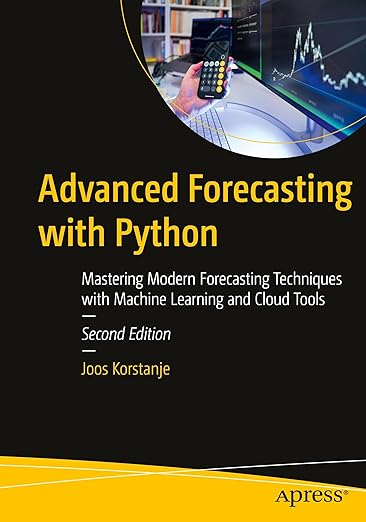
Master Modern Time Series Forecasting with Python and AI-Powered Models
Build accurate, scalable forecasting solutions using Python while exploring both traditional statistical techniques and the latest machine learning and AI-driven approaches. Advanced Forecasting with Python, Second Edition provides a practical, hands-on guide to modern predictive analytics, equipping you with the skills needed to tackle real-world forecasting challenges.
Book Overview
Forecasting plays a vital role in industries ranging from finance and retail to healthcare, manufacturing, and supply chain management. This fully updated second edition offers a comprehensive learning path that combines classical time series analysis with state-of-the-art machine learning and deep learning techniques, enabling readers to create reliable forecasting models for a wide variety of applications.
The journey begins with the fundamentals of time series forecasting, introducing proven statistical models such as Autoregressive (AR), Moving Average (MA), ARIMA, and SARIMA. Each concept is explained through intuitive discussions, mathematical foundations, and practical Python implementations that help you understand not only how the models work but also when to apply them.
Building on these foundations, the book explores advanced forecasting methods, including multivariate time series models such as VAR and VARMAX, as well as powerful supervised machine learning algorithms like Random Forests, XGBoost, LightGBM, and CatBoost. You’ll also dive into modern deep learning architectures—including LSTMs, N-BEATS, and Transformer models—to tackle complex forecasting tasks with greater accuracy.
A key feature of this edition is its expanded coverage of leading AI-powered forecasting platforms and cloud-based solutions. You’ll gain practical experience with technologies such as Orbit, AutoGluon, Prophet, Microsoft Azure AutoML, Google Cloud AutoML, and TimeGPT, helping you stay current with the latest advancements in predictive analytics and automated machine learning.
The book also emphasizes professional forecasting workflows, covering model evaluation, cross-validation, backtesting, experiment tracking with MLflow, deployment strategies, and the trade-offs between model accuracy, interpretability, and scalability.
By the end of this book, you’ll have the practical skills to develop, evaluate, deploy, and manage forecasting solutions using modern Python tools and industry-standard techniques.
What You Will Learn
- Build accurate forecasting solutions using Python
- Understand the mathematical foundations and intuition behind classical forecasting models
- Implement AR, MA, ARIMA, SARIMA, VAR, and VARMAX models
- Apply machine learning algorithms including Random Forests, XGBoost, LightGBM, and CatBoost
- Develop deep learning forecasting models using LSTMs, N-BEATS, and Transformers
- Evaluate forecasting models with cross-validation and backtesting techniques
- Track experiments and compare model performance using MLflow
- Leverage AI-powered forecasting platforms such as Prophet, Orbit, AutoGluon, and TimeGPT
- Explore cloud-based forecasting solutions with Microsoft Azure AutoML and Google Cloud AutoML
- Deploy scalable forecasting systems while balancing performance, explainability, and operational requirements
Who This Book Is For
This book is ideal for data scientists, business analysts, machine learning engineers, AI practitioners, quantitative analysts, and researchers working with time series data. Whether you’re expanding your forecasting knowledge or looking to master modern AI-powered forecasting techniques, this guide provides practical experience and real-world workflows for building production-ready predictive models.


Reviews
There are no reviews yet.