

Description
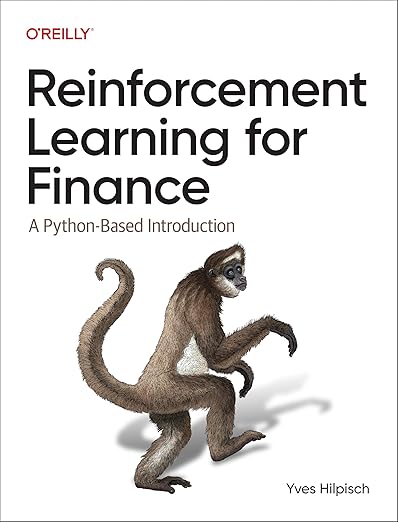
Reinforcement Learning for Finance: A Python-Based Introduction.
Reinforcement learning (RL) has emerged as one of the most influential branches of artificial intelligence, enabling machines to learn through experience and make increasingly effective decisions in complex environments. From mastering classic arcade games and defeating world-class players in strategy games to solving sophisticated optimization problems, reinforcement learning has demonstrated its ability to tackle challenges that traditional programming approaches often cannot. More recently, these techniques have begun transforming the world of finance, where intelligent decision-making under uncertainty is essential.
This book is among the first comprehensive guides dedicated to applying reinforcement learning techniques specifically to financial markets. It bridges the gap between modern AI research and practical financial applications, showing readers how advanced reinforcement learning algorithms can be used to address real-world problems in trading, portfolio management, and risk optimization.
Written by Dr. Yves Hilpisch, founder and CEO of The Python Quants, the book combines concise theoretical explanations with practical, implementation-focused examples. Rather than overwhelming readers with mathematical complexity, it introduces the core concepts needed to understand reinforcement learning before demonstrating how to build working solutions using Python. Every major algorithm is accompanied by self-contained code examples that readers can study, modify, and extend for their own financial applications.
The book begins with the foundations of reinforcement learning, explaining how intelligent agents learn by interacting with an environment, receiving feedback through rewards, and gradually improving their decision-making policies. Readers gain a solid understanding of key concepts such as states, actions, rewards, policies, value functions, exploration, and exploitation, providing the framework needed to understand more advanced methods.
Building on these fundamentals, the book explores Deep Q-Learning (DQL), one of the most widely used deep reinforcement learning algorithms. It explains how neural networks can be combined with Q-learning to solve high-dimensional decision problems, enabling AI agents to learn sophisticated strategies from complex financial data. Practical Python implementations demonstrate each step of the development process, making advanced concepts accessible to readers with programming experience.
The focus then shifts to applying reinforcement learning techniques to a variety of important financial challenges. Readers learn how intelligent agents can be developed for algorithmic trading, where they continuously adapt trading strategies based on changing market conditions. The book also explores dynamic hedging techniques for managing financial risk, as well as dynamic asset allocation methods that optimize portfolio decisions over time. Throughout these examples, reinforcement learning is presented as a practical tool for solving sequential decision-making problems that are difficult to address using traditional financial models.
Key topics covered include:
- The core principles and theory of reinforcement learning.
- Deep Q-Learning and modern reinforcement learning algorithms.
- Practical Python implementations with reusable, self-contained code.
- Applying reinforcement learning to algorithmic trading strategies.
- Dynamic hedging techniques for financial risk management.
- Intelligent portfolio optimization and dynamic asset allocation.
- Building, testing, and adapting reinforcement learning models for real financial applications.
Designed for machine learning practitioners, quantitative analysts, financial traders, portfolio managers, investment strategists, researchers, and software developers, this book serves as both a learning resource and a practical reference. Readers can work through the examples, customize the code for their own projects, and return to the book whenever they need guidance in developing reinforcement learning solutions for financial markets.
Combining artificial intelligence, quantitative finance, and Python programming, this timely resource offers a clear pathway into one of the fastest-growing areas of computational finance. Whether you are exploring reinforcement learning for the first time or seeking to incorporate advanced AI techniques into professional trading and investment systems, this book provides the knowledge, tools, and practical experience needed to harness the power of intelligent decision-making in finance.



Reviews
There are no reviews yet.