

Description
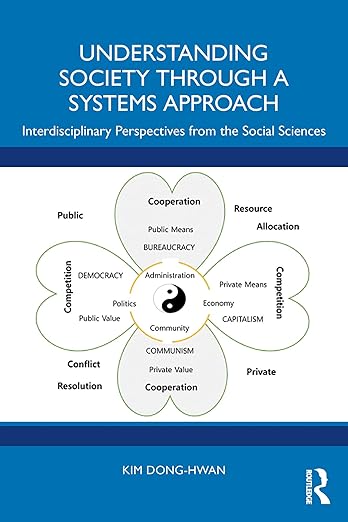
Kim presents an accessible, interdisciplinary textbook that uses systems theory as its main framework to help readers explore how the social sciences shape our understanding of society and its development over time.
Rather than treating disciplines in isolation, the book brings together politics, economics, administration, and community as the key pillars of society. It explains how each of these areas works, the systems that drive them, and how they have evolved through their interactions with one another.
At its core, the book shows that social science is not just a collection of separate subjects, but a connected whole made up of relationships and interdependent structures. Understanding these connections is central to understanding society itself.
What makes this work distinctive is its Eastern perspective. Instead of relying only on the traditional Western approach—often grounded in natural science methods and statistics—it draws on Eastern thought and real social phenomena to interpret how societies function. This offers a different way of thinking about social science and its methodology.
The book is designed for students of sociology, politics, economics, and related fields, and it encourages interdisciplinary thinking throughout. It also engages deeply with classical and modern thinkers such as Locke, Rousseau, Hobbes, Mill, Marx, Engels, Proudhon, Smith, Weber, Durkheim, Buber, Myrdal, Habermas, Popper, Hayek, Putnam, and others. By connecting their ideas, it helps readers see how these influential thinkers relate to one another and how their work contributes to a broader understanding of society.



Reviews
There are no reviews yet.